
Neural TTS is what happened when speech synthesis stopped sounding like a GPS unit reading turn directions. It uses deep neural networks to generate human-sounding speech from written text, and it's the reason a voice AI agent or an IVR menu can now sound like a person instead of a machine reciting a script.
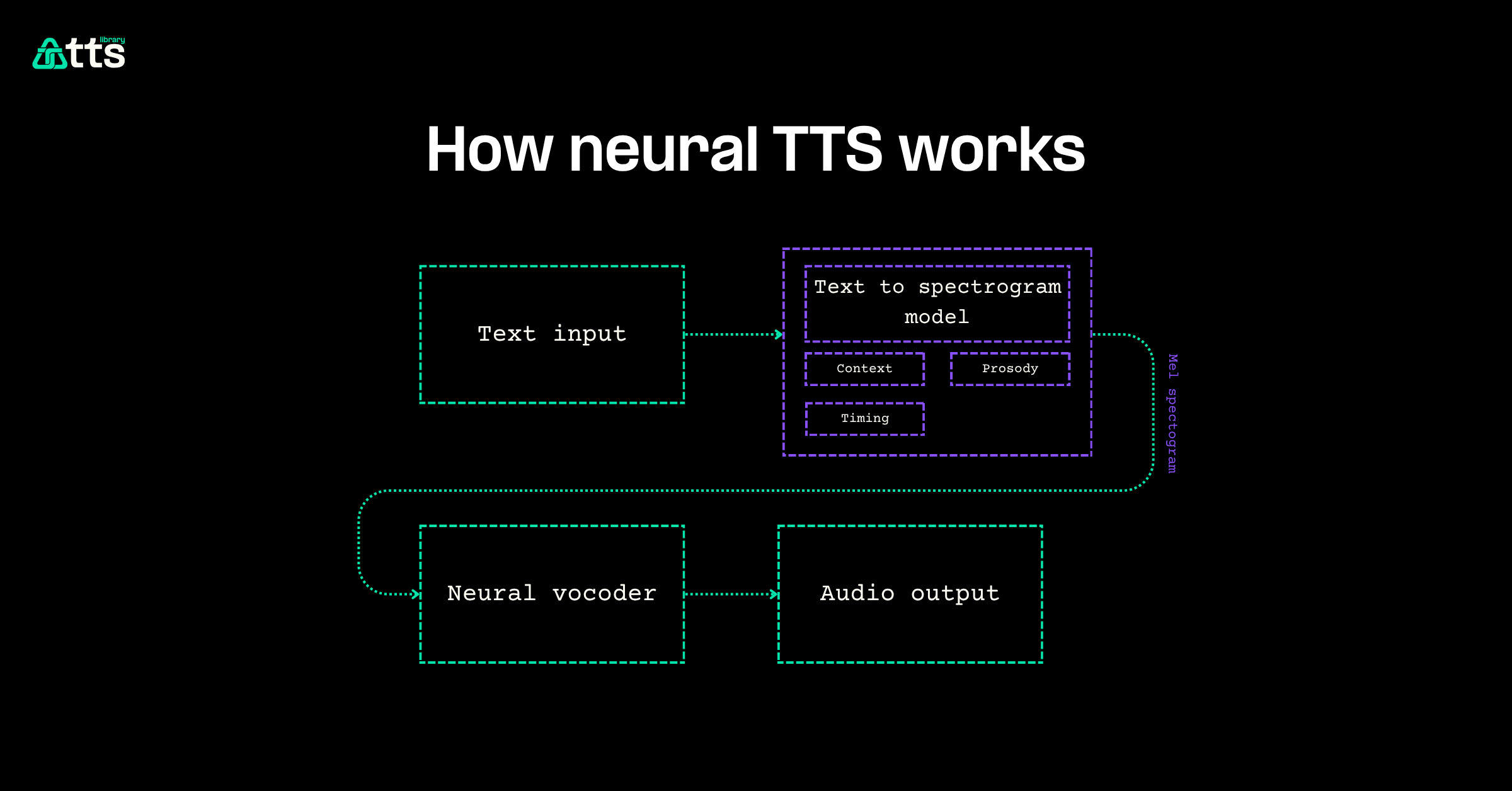
Every voice AI agent, IVR, and accessibility tool depends on TTS to speak. Neural TTS is why those voices sound natural now instead of mechanical.
Most Voice AI platforms sit on top of someone else's telephony stack. Telnyx runs the AI within our telephony layer.
Neural text-to-speech trains deep learning models on thousands of hours of recorded human speech. Rather than stitching pre-recorded clips together, the network learns the patterns of natural speech and generates audio from scratch, complete with the intonation, breath pauses, and emotional shading that made older systems so easy to spot as fake.
TL;DR
- Neural TTS uses deep neural networks to generate speech from text, producing natural intonation, emotion, and prosody that older systems cannot match
- Latency and voice quality are now the key benchmarks developers use to evaluate TTS APIs for production use cases
- Infrastructure determines neural TTS quality in production: co-located inference eliminates the network hops that add delay and degrade audio
For a broader overview of the technology, see what is TTS.
How neural TTS works
A neural TTS pipeline converts text to audio in three stages. Text analysis normalizes the input first, resolving abbreviations, numbers, and homographs into phonemes. From there, an acoustic model takes those phonemes and predicts a mel spectrogram, a time-frequency map of what the target audio should look like. A vocoder then turns that spectrogram into an actual waveform you can hear.
End-to-end models like VITS, introduced in 2021, collapse all three stages into a single network trained together rather than three networks trained separately.
| Stage | What it does | Example models |
|---|---|---|
| Text analysis | Tokenizes input, maps to phonemes | Grapheme-to-phoneme |
| Acoustic model | Predicts mel spectrogram | Tacotron 2, FastSpeech |
| Vocoder | Generates audio waveform | HiFi-GAN, WaveNet |
The breakthrough behind neural TTS was WaveNet, which DeepMind published in September 2016. It generated raw audio sample by sample using a deep autoregressive network, a huge leap in fidelity that also happened to be painfully slow to run. The models built since then chase the same quality while fixing that speed problem: parallel, non-autoregressive generation for real-time throughput, and conditioning inputs that let you control pacing and emotion instead of just accepting whatever the model gives you.
Neural TTS vs. older synthesis
Older TTS methods fall into two camps: concatenative and parametric. Neural TTS replaced both.
Concatenative synthesis spliced pre-recorded audio segments together. Each segment sounded fine on its own, but the seams between them gave it away. Parametric synthesis used statistical models to smooth those seams out, and the result was smoother but flatter, with a robotic quality that never quite disappeared.
Neural TTS generates the entire waveform from learned representations of human speech, which is why it picks up on things rule-based systems miss entirely: mid-sentence emphasis shifts, natural breath timing, the little vocal fingerprints that make one speaker sound different from another. Leading neural TTS models now cover 80+ languages and, remarkably, some can clone a voice from as little as a few seconds of reference audio, a huge drop from the roughly one-minute clips zero-shot cloning needed just a few years ago.
- Naturalness: the strongest 2026 models score in the 4.3 to 4.6 range on Mean Opinion Score evaluations, closing in on the 4.5 to 4.8 that human recordings typically earn
- Expressiveness: controllable emotion, pacing, and speaking style through conditioning inputs
- Multilingual: single models handle dozens of languages and regional accents
- Voice cloning: reproduce a target voice from a short reference clip
Why infrastructure matters for neural TTS
A neural TTS model is only as fast as the infrastructure serving it. In conversational voice AI, the gap between one person finishing a sentence and the other starting theirs runs about 200 to 300 milliseconds in ordinary human conversation. An AI pipeline has to get close to that to feel natural, and neural TTS is just one leg of that trip: every network hop between the TTS engine and the telephony layer eats into the budget.
A 1-second delay can spike call abandonment by 23% and kills natural conversation. Most AI voice projects fail because they're stitched together from too many APIs and vendors.
Multi-vendor stacks are the usual bottleneck. A published latency comparison breaks down why: a typical stitched pipeline, network ingress, speech-to-text, an LLM call, then text-to-speech across separate vendors, adds up to roughly 1,210 milliseconds. Run that same pipeline co-located on one network and it drops to around 450 milliseconds. That gap is almost entirely vendor-boundary overhead, and it's the difference between a conversation that flows and one that feels like a bad phone connection.
How it relates to Telnyx
Telnyx runs neural TTS inference on GPUs co-located with its carrier-grade telephony network, so there are no inter-provider hops and no detour through the public internet. The TTS API provides access to voices from multiple providers through a single endpoint, with HD audio quality and predictable latency.
As of August 2026, that same philosophy extends past TTS itself: Telnyx launched Edge Compute, an agent runtime that lets an entire voice AI agent, its code, state, speech-to-text, and text-to-speech, run on infrastructure Telnyx owns rather than being wired together across separate vendors. The pitch is the same one that applies to TTS alone: fewer hops between components tends to mean a faster, steadier conversation.
To get started with neural TTS on Telnyx:
- Create a Telnyx account and generate an API key
- Choose a voice and engine through the TTS API
- Connect TTS output to a voice AI agent or integrate via the real-time API
- Monitor latency and quality from the Telnyx portal
Frequently asked questions
What does neural TTS mean?
Neural TTS stands for neural text-to-speech. It refers to speech synthesis systems that use deep neural networks to convert written text into spoken audio. The "neural" part is what separates it from older rule-based or concatenative approaches.
Is neural TTS the same as AI voice?
Neural TTS is one component of AI voice systems. A full voice AI agent combines speech-to-text, an LLM for reasoning, and neural TTS for generating the spoken response. Neural TTS handles the last mile: turning text into audio.
How realistic is neural TTS in 2026?
Modern neural TTS models produce speech that trained listeners often struggle to distinguish from human recordings, with top models now scoring 4.3 to 4.6 on Mean Opinion Score evaluations against a human baseline of roughly 4.5 to 4.8. That gap has gotten so narrow that researchers are moving past MOS as a sole measuring stick: an ICLR 2026 benchmark called TTSDS2 was built specifically because traditional opinion-score testing struggles to reliably separate today's best synthetic speech from the real thing. Alongside that, voice cloning from a short reference sample has become standard rather than exceptional.
What is the best neural TTS for developers?
The best neural TTS depends on the use case. Key factors are latency, voice quality, language support, and cost. The STT and TTS router approach lets developers test multiple engines through a single API without rebuilding integrations.
Does neural TTS work in real time?
Yes. Modern neural TTS models generate audio fast enough for live conversation when served on optimized infrastructure. Latency depends more on the serving architecture than the model itself: co-located inference eliminates the network overhead that slows down multi-vendor stacks.