
What Is TTS? From text to voice at scale
I run into text-to-speech several times a day and rarely notice it: the voice reading out a delivery update, the narrator in a language app, the assistant confirming a reservation. The market is catching up to that quiet ubiquity. MarketsandMarkets projects the global text-to-speech market will grow from roughly $4.66 billion in 2025 to $7.6 billion by 2029, a 13.7% CAGR. The teams building with TTS APIs right now are the ones shipping voice AI faster, cheaper, and at real scale.
What is TTS?
Text-to-speech (TTS) is technology that converts written text into spoken audio.
You send text in, you get a natural-sounding voice out. That's the entire premise, and it might be one of the more honestly named technologies in the stack.
AI is like what the internet was in… 1987, but beyond.
TTS powers everything from screen readers and navigation prompts to conversational AI IVR systems and real-time voice agents. The core use case barely changes from one application to the next: deliver spoken audio from text, on demand, at whatever scale you need.
What's changed is the how. Legacy TTS stitched together prerecorded clips, and you could hear the seams. Modern neural TTS generates speech synthetically, producing more natural prosody, better intonation, and far more language and voice variety. With a TTS API, you can wire that capability into any application with a single endpoint call.
How TTS works
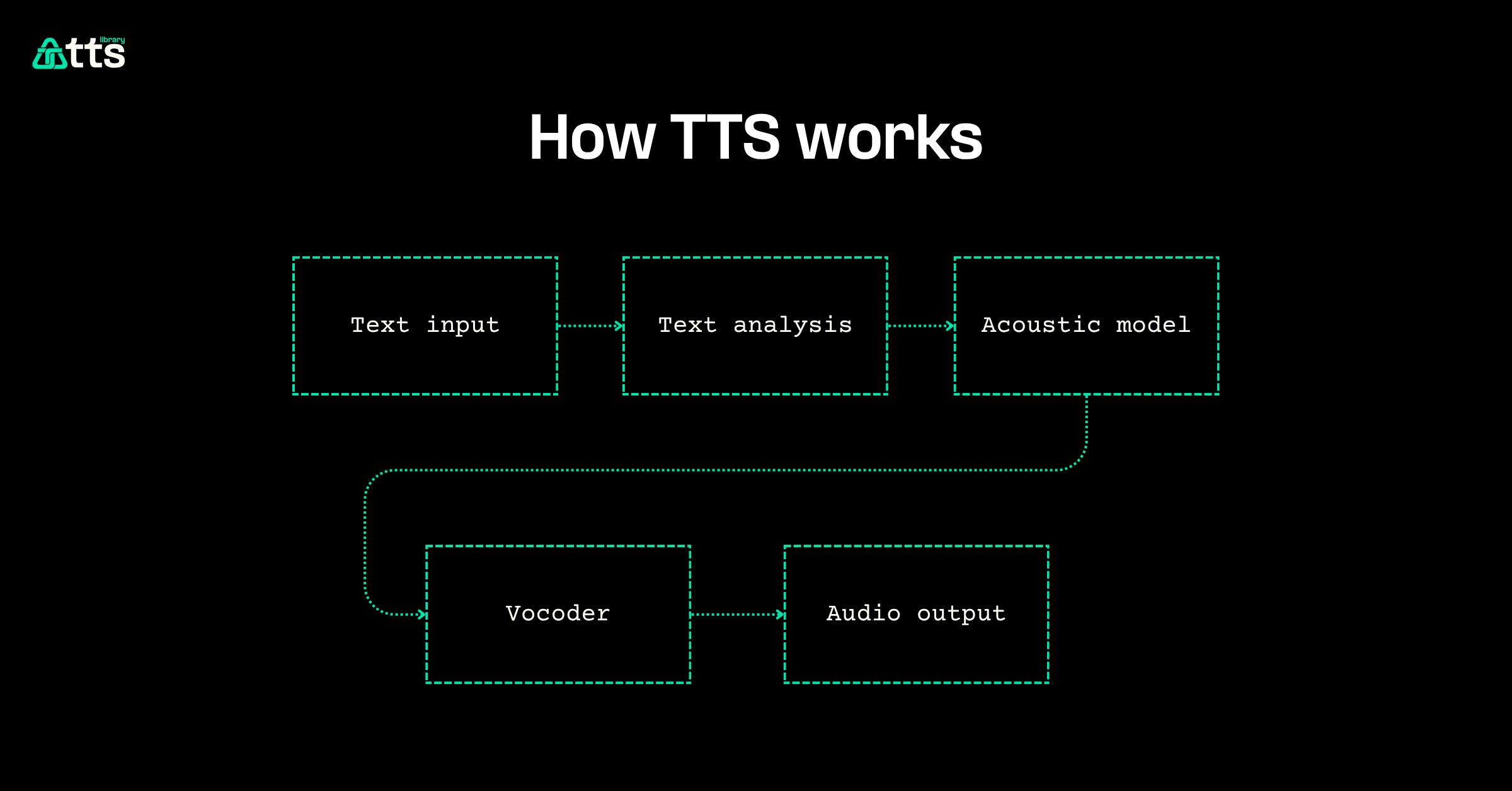
A modern TTS pipeline runs through three stages:
- Text analysis: the input text gets normalized and tokenized. Abbreviations expand, numbers convert to words, and punctuation drives phrasing decisions.
- Acoustic modeling: a neural network, typically a sequence-to-sequence variant, maps the processed text to an acoustic representation: a spectrogram or mel-spectrogram encoding pitch, duration, and energy for each phoneme.
- Vocoder synthesis: a second model, the vocoder, converts that acoustic representation into a waveform, the actual audio you hear. Neural vocoders like WaveNet and HiFi-GAN produce audio that comes close to indistinguishable from a human voice.
I think the latency budget across this pipeline matters more than most teams plan for. Every stage adds processing time, and if your TTS provider runs inference in a different region than your call termination, you're paying 30 to 80ms of network overhead per hop before synthesis even starts. That's the practical case for co-located TTS inference in real-time applications like voice AI agents and cloud IVR.
Key benefits of TTS
Scalable voice output
TTS generates speech on demand without recording studios, voice talent, or post-production. One API call replaces an entire audio production pipeline. For teams running contact centers, that means updating scripts, adding languages, and changing voices in minutes instead of weeks.
Lower operational costs
Telnyx's own voice AI pricing puts a full-stack conversational AI agent, orchestration, STT, and TTS bundled together, at a $0.05 per minute base rate, with an all-in cost (including LLM tokens and telephony) landing around $0.056 per minute. Compare that to the fully loaded cost of a human agent handling the same interaction, and at scale the gap is significant. It matters because 88% of customers, per Salesforce's State of the Connected Customer research, say the experience a company provides is as important as its product. TTS lets you deliver that consistent experience without the overhead of a human-staffed alternative.
Accessibility and reach
TTS makes written content accessible to people with visual impairments, reading disabilities, or language barriers. The International Dyslexia Association estimates that 15 to 20% of the population, roughly 1 in 5 people, shows some symptoms of dyslexia, and 70% of Gen Z respondents in a Preply survey said they watch most video content with captions or subtitles on. TTS closes the gap between text content and the people who need it spoken.
Real-time responsiveness
Modern TTS APIs stream audio in real time, so playback can start before synthesis finishes. For voice AI and conversational AI use cases, sub-200ms response time is the difference between a natural conversation and an awkward pause.
| Benefit | Legacy TTS | Modern API-first TTS |
|---|---|---|
| Latency | 500ms+ | Sub-200ms |
| Voice quality | Robotic, concatenated | Neural, natural prosody |
| Scaling | Manual recording pipelines | API calls, auto-scaling |
| Language support | Limited per-voice | 30+ languages per model |
| Cost per minute | High (studio + talent) | ~$0.05–0.06/min |
Common use cases
Customer support and IVR
TTS powers interactive voice response (IVR) systems that guide callers through menus, provide account information, and route calls. With HD text-to-speech, IVR menus sound natural instead of robotic, which cuts down on caller frustration and drop-off.
Conversational AI and voice agents
The fastest-growing TTS use case is real-time voice AI. Voice AI agents combine speech-to-text (STT), a large language model (LLM), and TTS into a single conversational loop. The TTS layer is what makes the agent speak back, and its latency directly determines how natural the conversation feels. A 2023 survey of more than 950 contact center agents found 59% at risk of burnout, including 28% at high risk. Voice agents with responsive TTS can absorb the routine, repetitive interactions and free human agents for the calls that actually need a person.
Accessibility tools
Screen readers, reading assistants, and content narration tools all rely on TTS. Pew Research found that nearly a quarter of U.S. adults, 23%, listened to an audiobook in 2021, up from 20% two years earlier. TTS is what makes dynamic content like emails, articles, and notifications available in audio form without anyone pre-recording it.
Embedded and IoT devices
Smart speakers, car infotainment systems, and wearable devices use TTS to deliver spoken feedback from text-based data sources. The TTS API with Python makes it straightforward to integrate text-to-speech into embedded applications with minimal code.
How Telnyx approaches TTS
Telnyx delivers TTS as part of a full-stack voice AI platform, not as a standalone synthesis service. The difference comes down to infrastructure.
As of this writing, that platform proxies voices from nine engines, Telnyx, MiniMax, Azure, Inworld, Resemble, Murf, AWS, XAI, and Humain, totaling nearly 3,900 voices across 88 languages and more than 200 locale variants. Humain, a Saudi Arabian TTS vendor, is the newest addition: its voices had been quietly flowing through the catalog for weeks before the audio pipeline was fully wired up on August 18, 2026. That kind of rapid provider sprawl is normal now. New TTS engines show up faster than most teams can vet them, which is exactly why routing them through one proxied API instead of juggling separate integrations is worth the switch.
Co-located inference
Telnyx runs TTS inference on GPUs co-located with its carrier-grade telephony network. No inter-provider hops, no public internet routing between vendors. The result is sub-200ms round-trip times, because co-location removes the latency that multi-vendor architectures can't avoid, no matter how well they're optimized.
HD voice codecs
Wideband 16 kHz codecs come standard, delivering richer, clearer audio than narrowband telephony. Paired with built-in noise suppression, Telnyx TTS produces speech that sounds like a person, not a pipeline.
Integrated STT + TTS + LLM stack
Telnyx offers speech-to-text, text-to-speech, and AI inference on one platform. That means one SLA, one bill, one support escalation path, and no Frankenstack of vendors to coordinate. The STT TTS router lets you orchestrate both directions of the voice pipeline without duct-taping separate providers together.
Real-time streaming
The real-time TTS API streams audio as it's generated, so playback starts before synthesis completes. For conversational AI, that streaming behavior is what separates a responsive agent from one with an awkward pause built into every turn.
Competitive pricing
Telnyx TTS is part of a full-stack voice AI offering priced from $0.05 per minute that bundles STT, TTS, and inference together. Compare that to ElevenLabs or other standalone TTS providers, which charge per-character on top of separate telephony and inference costs you have to assemble yourself. TTS benchmarks show Telnyx delivering competitive quality at a fraction of the per-minute cost.
Getting started
Building with TTS requires neither a recording studio nor a PhD in speech synthesis. A modern TTS API gives you programmatic access to neural text-to-speech in a few lines of code.