
Voice cloning is an AI technique that builds a synthetic copy of one specific person's voice from a sample of their recorded speech. Feed a model anywhere from a few seconds to a few minutes of reference audio, and it learns the voice's unique fingerprint well enough to generate entirely new sentences the person never actually said.
The technology jumped from research labs to consumer apps fast. Platforms like ElevenLabs, Resemble.ai, and the open-source OpenVoice project out of MIT and MyShell, alongside Telnyx, can now reproduce a recognizable voice from under a minute of audio. That accessibility is exactly what makes voice cloning both powerful and contentious: the same capability that lets someone who lost their voice keep speaking also lets a scammer impersonate a CEO on a phone call.
TL;DR
- Voice cloning replicates one specific person's voice from reference audio; text-to-speech generates speech in a generic, preset voice
- Modern models clone a voice from seconds of audio using speaker embeddings and neural synthesis, with quality ranging from instant zero-shot copies to high-fidelity fine-tuned ones
- Consent and disclosure are legal requirements now, not just best practice: the FTC has finalized enforcement rules against AI impersonation of businesses and government, with an extension covering individuals still pending, and the EU AI Act's labeling rules for synthetic audio took effect on August 2, 2026
How voice cloning works
Voice cloning happens in two phases: capturing the voice, then generating speech with it.
During capture, a model analyzes the reference audio and compresses everything distinctive about the voice, including its timbre, pitch range, accent, and rhythm, into a compact numerical representation called a speaker embedding. Think of it as the voice's digital fingerprint. It separates who is speaking from what is being said.
During generation, a neural text-to-speech model takes new text plus that speaker embedding and synthesizes a waveform that sounds like the target speaker reading it. Because the embedding is decoupled from the content, the cloned voice can say anything, in any supported language, with controllable emotion and pacing.
There are two broad approaches, and they trade speed for fidelity:
- Zero-shot (instant) cloning builds a usable voice from a single short clip, often just a few seconds, with no model retraining. It is fast and convenient, which is why it powers most in-product "instant clone" features, including the zero-shot cloning inside the Telnyx portal.
- Fine-tuned cloning trains or adapts a model on several minutes to hours of a speaker's audio. It takes longer and needs more data, but it captures subtle vocal details and produces the highest-fidelity results, which is why professional dubbing and audiobook work tends to lean on it.
Voice cloning vs. voice synthesis vs. TTS
These terms get thrown around interchangeably, but they describe different things. The distinction that matters is whose voice comes out.
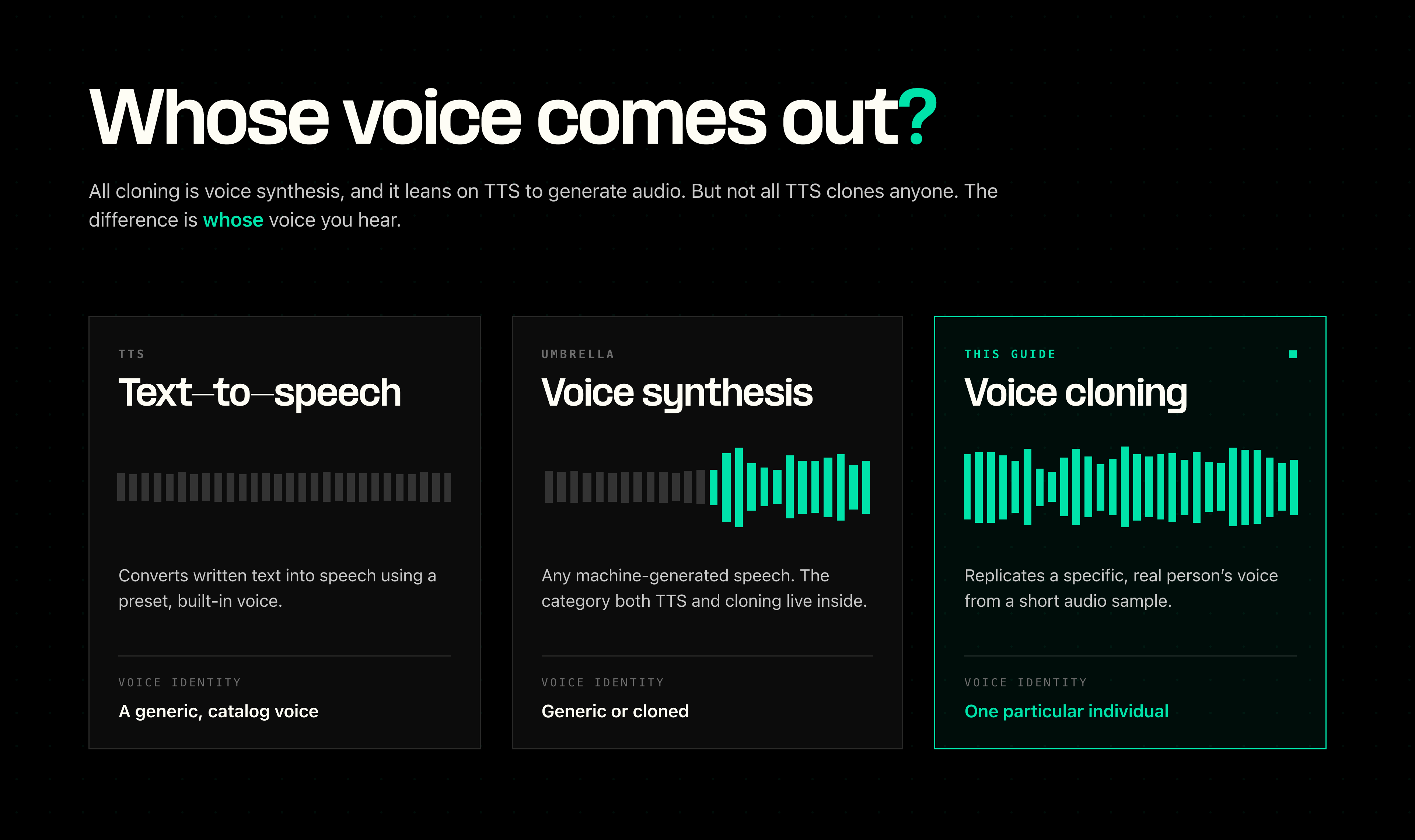
| Concept | What it is | Voice identity |
|---|---|---|
| Text-to-speech (TTS) | Converts written text into spoken audio using a preset voice | A generic, built-in voice |
| Voice synthesis | The umbrella term for any machine-generated speech | Generic or cloned, depending on the system |
| Voice cloning | Replicates a specific, real person's voice from samples | A particular individual |
Put simply, voice cloning is a form of voice synthesis and it relies on TTS techniques to generate the audio, but plenty of TTS never touches cloning at all. A standard TTS API reads your text in one of its catalog voices. A cloning system learns a target person's voice first, then reads your text back in that voice. For the full picture of the underlying generation technology, see what is TTS and what is neural TTS.
Common use cases
Voice cloning covers a wide range of legitimate applications, plus a smaller set of clearly abusive ones that drive most of the regulation.
- Localization and dubbing: Reproduce a presenter's or actor's voice across languages so dubbed content keeps the original speaker's identity instead of swapping in a stranger.
- Accessibility and voice banking: People facing voice loss from conditions like ALS can bank their voice while they still can, then continue to "speak" in it through an assistive device.
- Conversational agents and IVR: Give a brand a single, consistent voice across every automated call, or let an agent speak in a named persona without re-recording prompts.
- Content production: Audiobook narration, podcasting, and video voiceover, where a creator can fix a mistake or add a line without booking studio time.
- Personalization: Navigation, virtual assistants, and games that speak in a chosen or familiar voice.
The abusive uses mirror the legitimate ones almost exactly: impersonation scams, fraudulent authorization of payments, and non-consensual deepfakes. That tension is why consent sits at the center of every responsible deployment.
Ethics, consent, and legal considerations
Consent is the line that decides whether voice cloning is ethical. Cloning your own voice, or a voice you have explicit permission and rights to use, is legitimate. Cloning someone else's voice without their knowledge is behind nearly every harm in this space, from "grandparent" scams built on a cloned relative's voice to fabricated audio of public figures.
Regulators have been moving fast, though the details are more nuanced than the headlines suggest. In the United States, the FTC ran a Voice Cloning Challenge that produced four winning detection and authentication tools in 2024, and separately finalized an impersonation rule that took effect in April 2024, giving it stronger enforcement tools against AI-driven impersonation of government agencies and businesses. That finalized rule does not yet reach individuals: the FTC proposed extending the same protections to personal impersonation back in February 2024, held a hearing on the proposal in January 2025, and as of this writing the extension is still moving through rulemaking rather than in force. In the European Union, Article 50 of the EU AI Act requires synthetic or manipulated audio to be marked in a machine-readable format and disclosed to the people who hear it. Those transparency obligations took effect on August 2, 2026, with a transition period running to December 2, 2026 for the marking and detection requirements on generative systems that were already on the market before that date.
New as of this year: the US is also edging toward its own federal right covering voice and likeness. The bipartisan NO FAKES Act, which would let a person control unauthorized AI replicas of their voice and face, unanimously cleared the Senate Judiciary Committee in June 2026. It still needs to pass the full Senate and House before it becomes law, so it is not a compliance requirement yet, but anyone building products that touch cloned voices in the US should be watching it closely.
For anyone building with this technology, a few practices have become table stakes: get explicit, documented consent from the person whose voice is cloned; disclose to listeners when a voice is AI-generated; restrict cloning of third-party voices; and keep an audit trail. Treat these as product requirements rather than legal afterthoughts, and you will be ahead of wherever the law lands next.
How it relates to Telnyx
Telnyx builds zero-shot voice cloning into its Voice Design Lab, alongside a curated catalog of high-quality, licensed neural voices, all reachable through a single text-to-speech API for voice AI agents and IVR. You can clone a voice from a short recording using either Telnyx's own Qwen3TTS model, tuned for brief 3 to 15 second reference clips, or MiniMax, which handles longer references from 10 seconds up to five minutes. Once a cloned voice exists, it works anywhere Telnyx supports text-to-speech, including AI Assistants, Call Control speak commands, and the TTS API itself. Because cloning lives inside the platform, the consent and disclosure practices above come with the territory.
Most Voice AI platforms sit on top of someone else's telephony stack. Telnyx runs the AI within our telephony layer.
I think that co-located design matters most for a synthetic voice in a live conversation: running speech generation next to the carrier network strips out the cross-vendor network hops that add latency and break the feel of natural dialogue.
To build with neural voices on Telnyx:
- Create a Telnyx account and generate an API key
- Browse voices in the TTS Library and pick one through the TTS API
- Connect the voice to a voice AI agent for end-to-end conversational calls
Frequently asked questions
Is voice cloning legal?
Voice cloning itself is legal in most places, but how you use it is heavily constrained. Cloning your own voice or a voice you have rights to is generally fine. Cloning someone else's voice without consent can violate impersonation, fraud, publicity, and biometric-privacy laws. In the US, the FTC already has enforcement tools against AI impersonation of businesses and government, with a rule extending that to individuals still pending, and in the EU the AI Act now requires labeling synthetic audio.
How much audio do you need to clone a voice?
It depends on the method. Zero-shot cloning can produce a recognizable clone from just a few seconds of audio. Higher-fidelity, fine-tuned clones used for professional dubbing or audiobooks typically use several minutes to a few hours of clean recordings.
What is the difference between voice cloning and a deepfake?
Voice cloning is the underlying technology that replicates a voice. A deepfake is a specific, usually deceptive output: synthetic audio or video made to look or sound like a real person did something they did not. Cloning becomes a deepfake when someone uses it to impersonate a person without consent or disclosure.
Can you detect a cloned voice?
Sometimes, and increasingly so. Detection and watermarking tools, several of which won recognition in the FTC's Voice Cloning Challenge, look for artifacts in synthetic audio or embed imperceptible signals that mark a clip as AI-generated. Detection still falls short of foolproof, which is exactly why disclosure rules like the EU AI Act's matter.
Is voice cloning the same as text-to-speech?
They're related but distinct. Standard text-to-speech reads your text in a generic, built-in voice. Voice cloning first learns one specific person's voice, then uses text-to-speech techniques to generate new speech in that particular voice. All cloning relies on synthesis, but standard TTS never clones anyone.